In the morning 118/76, at noon after climbing the stairs 152/94, in the evening before watching TV again 125/80. Anyone who sits down at home with the measuring device on the living room table quickly realizes: Blood pressure is not a fixed number. This is normal. What matters is how you measure, as this determines whether your values mean something to the doctor or just cause confusion.
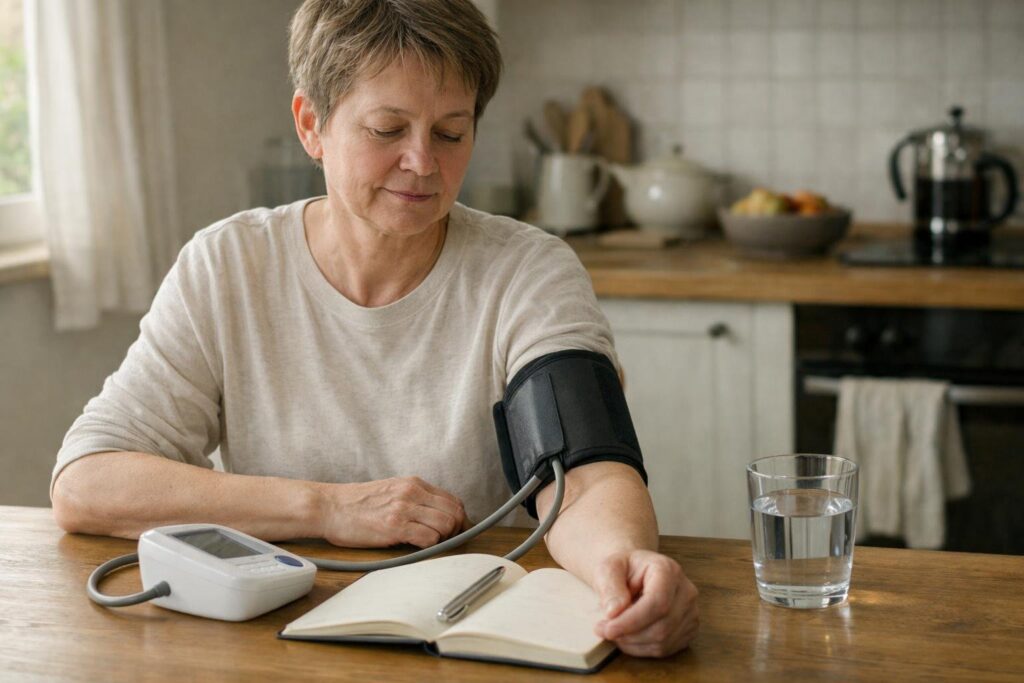
Why Measuring at Home Often Says More Than in the Office
In the doctor’s office, some people’s blood pressure rises simply due to the situation: white coat, waiting room, time pressure. Experts refer to this as the white coat effect. Conversely, there are people who appear normal in the office but have elevated values at home.
Measurements in your everyday life provide a picture over many days instead of a single snapshot. Therefore, European guidelines explicitly recommend self-measurement as a complement to office measurements, both for diagnosis and for monitoring treatment.
The Right Device
For everyday use, an upper arm device is suitable. Wrist devices are more sensitive to positioning errors and therefore often provide incorrect values. Finger devices are not recommended for home measurement.
- Proven Accuracy: Ensure that the device has been tested in an independent validation study. The German Hypertension League awards a certification seal for this and maintains a list of validated devices.
- Proper Cuff: If it is too narrow, the device will display values that are too high. Measure the upper arm circumference and choose the size accordingly. For larger upper arms, the standard cuff is often insufficient.
- Easy Operation: A large display and memory make recording easier. The device and cuff should be compatible.
Before Measurement: Five Minutes of Rest
Most measurement errors occur in the minutes beforehand. If you have just come up the stairs, taken care of the dog, or are upset about a message, you will measure higher values than your actual resting pressure.
- Sit quietly for at least five minutes, without your phone and conversation.
- Do not consume coffee, cigarettes, or exercise for about half an hour before measuring.
- Go to the bathroom beforehand, as a full bladder can raise the values.
- Expose your upper arm. A rolled-up sleeve that constricts the arm distorts the result.
Posture: How to Sit Correctly
Sit upright on a chair, with the backrest supporting you, and both feet flat on the floor. Do not cross your legs. The arm should rest on a table, with the cuff at heart level, approximately in the middle of the breastbone. If the arm is too low, the values will be too high.
The cuff should sit directly on the skin of the upper arm, with the lower edge one to two centimeters above the elbow crease. The tube should point towards the palm. While the device is measuring, breathe calmly and do not speak. Even a brief conversation can noticeably increase the value.
How Often and When to Measure?
A single value is not helpful. A fixed schedule over a week is common:
- Measure for seven days each morning and evening, in the morning before breakfast and before taking prescribed medications.
- At each opportunity, take two measurements spaced one to two minutes apart.
- Record both values and the pulse. A table on paper is sufficient.
- Calculate the average at the end. Experts often disregard the values from the first day because measurements are usually more tense at the beginning.
It is also worthwhile to measure on both arms the first time. If the differences are consistently significant, talk to your doctor. After that, measure on the arm with the higher values.
What Values Are Considered Concerning?
At home, slightly lower thresholds apply than in the office because the environment is more relaxed. According to European guidelines, the threshold for high blood pressure in office measurements is 140/90 mmHg, while for self-measurement it is an average of 135/85 mmHg.
An average above this mark is not yet a diagnosis. It is a reason to have the values assessed by a doctor, possibly with a 24-hour monitoring. You can find more about causes and treatment in our overview Understanding High Blood Pressure.
Typical Mistakes and Their Consequences
- Too short a pause before measurement: values usually too high.
- Cuff too small or over thick clothing: values too high.
- Arm hanging down: values too high. Arm raised above heart level: values too low.
- Legs crossed, back unsupported: values rise.
- Measuring in pain, stress, or after an argument: the result reflects the moment, not your everyday life.
- Constantly re-measuring: Those who measure ten times a day will become more nervous than better informed. A calm routine beats constant monitoring.
If you are already tense, it can sometimes help to organize the sources of stress in your daily life. Suggestions for this are provided in the article Stress Management and Burnout Prevention.
When to See a Doctor Immediately
A high value alone is rarely an emergency. It becomes dangerous in conjunction with symptoms. Call emergency services at 112 if a significantly elevated value is accompanied by any of these signs:
- Severe chest pain or pressure in the chest
- Shortness of breath
- Sudden paralysis, numbness, or drooping of the mouth corner
- Speech disturbance or sudden vision disturbance
- Very severe, unusual headache
Without such symptoms, repeat the measurement after a break of a few minutes. If the values remain significantly elevated for several days, schedule an appointment promptly. Do not stop or change prescribed medications on your own. That decision is solely up to the doctor. Very low values accompanied by dizziness or fainting also require medical evaluation.
Frequently Asked Questions
Which Arm is the Right One?
Measure both arms the first time. After that, stick with the arm that has the higher values. Small differences of up to about 10 mmHg are not unusual.
Should I Measure Before or After Breakfast?
For monitoring, measuring in the morning before breakfast and taking medications is common. It is especially important to measure at similar times each day so that the values remain comparable.
My Device Shows Something Different Each Time I Measure. Is It Defective?
Fluctuations of a few mmHg between two measurements are normal, as blood pressure changes with each heartbeat and breath. Bring the device to your next doctor’s appointment and have it compared with the office measurement.
Also Read
- Understanding High Blood Pressure: Causes, Symptoms, and Effective Solutions Against Hypertension
- Cardiovascular Diseases: Prevention and Ways to a Healthy Heart
- Stress Management and Burnout Prevention: Ways to More Well-Being in Everyday Life
This article is for informational purposes only and does not replace medical advice.
Sources
- Williams B. et al.: 2018 ESC/ESH Guidelines for the management of arterial hypertension. European Heart Journal 2018;39(33):3021–3104.
- Mancia G. et al.: 2023 ESH Guidelines for the management of arterial hypertension. Journal of Hypertension 2023;41(12):1874–2071.
- German Hypertension League e. V. DHL – German Society for Hypertension and Prevention: Patient information on blood pressure self-measurement and certification seal for validated blood pressure measuring devices.