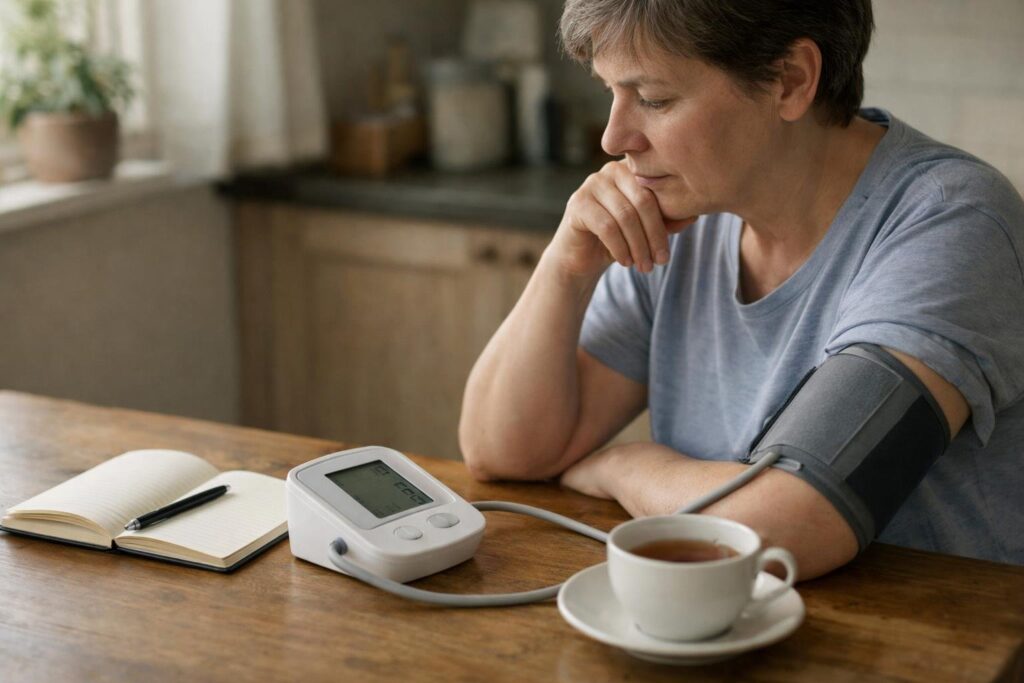
The display shows 138/87, and the pondering begins. Is that still okay? Should I be worried? The doctor only said “just fine” last time. Two numbers, a slash, and hardly anyone knows exactly what it means. Yet, the most important aspects can be clarified in just a few minutes.
What the Two Numbers Measure
The first, higher number is the systolic value. It occurs when the heart contracts and pumps blood into the vessels. The second is the diastolic value, the pressure during the pause between two beats when the heart is refilling. Both are expressed in millimeters of mercury, abbreviated as mmHg.
The height of the numbers depends on the elasticity of the vessels, the pumping capacity of the heart, and the blood volume. Both values matter. In younger people, the lower value is often elevated, while in older age, the upper value usually increases because the vessels become stiffer.
The Classification According to European Guidelines
In Germany, doctors refer to the classification of the European societies for hypertension (ESC/ESH). This applies to measurements in practice and distinguishes these ranges:
- Optimal: under 120/80 mmHg
- Normal: 120–129 / 80–84 mmHg
- High normal: 130–139 / 85–89 mmHg
- Hypertension Grade 1: 140–159 / 90–99 mmHg
- Hypertension Grade 2: 160–179 / 100–109 mmHg
- Hypertension Grade 3: from 180 / from 110 mmHg
It is sufficient if one of the two values falls into a category. If the upper value is 150 and the lower is 82, the classification is based on the higher value. If the lower value remains below 90 and the upper rises to 140 or more, experts refer to this as isolated systolic hypertension.
Back to 138/87: That is high normal. No alarm, but a reason to keep an eye on the value and review daily habits.
A Single Measurement Says Little
Blood pressure fluctuates throughout the day, with every staircase, every phone call, every coffee. At night it drops, shortly after waking it rises. Therefore, hypertension is not determined by a single value. Doctors want to see multiple measurements at different times, often supplemented by self-measurements or a 24-hour measurement.
How to measure accurately at home is detailed in our article Measuring Blood Pressure Correctly at Home. Those who measure inaccurately end up with incorrect numbers.
Practice, Home, 24 Hours: Why the Limits Differ
The same person has different values depending on the situation, which is why different thresholds apply based on the measurement method. According to the ESC/ESH guidelines, the threshold for hypertension is:
- in practice at 140/90 mmHg,
- at home self-measurement averages at 135/85 mmHg,
- in the 24-hour measurement, the daily average is 135/85 and the average over the entire day is 130/80 mmHg.
This also explains frequent confusion. If the practice shows 145/92 and at home you get 128/80, it suggests the white coat effect. Conversely, there is masked hypertension: normal in practice, consistently high at home. Both can only be recognized with measurements outside the practice.
What an Elevated Value Means and What It Doesn’t
A value above the threshold is not a diagnosis. Only repeated measurements and a medical consultation can determine that. The doctor will also look at other factors: age, diabetes, cholesterol, smoking, kidney values, family history. From this overall situation, it will be decided whether to change habits first or if medication is advisable.
High blood pressure usually doesn’t hurt. Many feel nothing for years while the vessels, heart, and kidneys quietly suffer damage. Head pressure or ringing in the ears are not reliable warning signs. That’s why measuring is worthwhile, even if you feel fine.
Want to understand what lies behind it in the long term? A broader overview is provided in the article Understanding Hypertension.
And What If the Value Is Too Low?
Low blood pressure, unlike high, is often noticeable: dizziness when standing up, blacking out before the eyes, fatigue. There is no fixed threshold. What matters is whether symptoms are present. If someone naturally has a reading of 105/65 and feels fine, they typically have no problem.
It becomes concerning if the values are newly and significantly lower than usual, if you fall or nearly faint, or if you are taking blood pressure medications. Do not change anything yourself; instead, consult the prescribing doctor.
When You Should See a Doctor Immediately
Call emergency services at 112 if a significantly elevated value comes with any of these signs:
- severe pressure or pain in the chest
- shortness of breath
- sudden paralysis, numbness, or drooping of the mouth
- sudden speech or vision disturbances
- very severe headache like you’ve never had before
- fainting or confusion
Without such symptoms, the rule is: measure again after a break. If the values remain elevated over several days, schedule an appointment soon. Do not stop prescribed medications on your own.
Frequently Asked Questions
When is blood pressure too high?
For practice, the threshold is at 140/90 mmHg, for the average of self-measurements at home at 135/85 mmHg. Individual outliers do not count. What matters are repeated measurements.
Is the upper or lower value more important?
Both. In older age, the upper value is often considered particularly indicative of cardiovascular risk, but either value can determine the classification.
Why is my value higher in practice than at home?
Excitement and time pressure raise the pressure in practice. This is common and has a name: white coat effect. Whether it applies to you can be clarified with self-measurements or a 24-hour measurement.
Also Read
- Measuring Blood Pressure Correctly at Home: How to Achieve Reliable Values
- Understanding Hypertension: Causes, Symptoms, and Effective Solutions Against Hypertension
- Cardiovascular Diseases: Prevention and Ways to a Healthy Heart
This article is for informational purposes only and does not replace medical advice.
Sources
- Williams B. et al.: 2018 ESC/ESH Guidelines for the management of arterial hypertension. European Heart Journal 2018;39(33):3021–3104.
- Mancia G. et al.: 2023 ESH Guidelines for the management of arterial hypertension. Journal of Hypertension 2023;41(12):1874–2071.
- German Hypertension League e.V. DHL – German Society for Hypertension and Prevention: Patient Information on Blood Pressure Measurement.