Your back has been bothering you for days, and the first impulse is clear: lie down, rest, wait it out. By the third day on the couch, your back feels stiffer than before. This is no coincidence. For common, non-specific lower back pain, guidelines advise against bed rest and promote movement. What exercises are suitable to start with, how much pain is acceptable, and when you should seek medical advice, you can read here – aimed at those who sit a lot and want to trust their back again.
Three Days on the Couch – and the Back is Stiffer than Before
The National Guideline for Back Pain states it plainly: those affected should maintain their physical activity as much as possible; bed rest is discouraged. While lying down may relieve the spine temporarily, the muscles that support it quickly weaken, and joints that aren’t moved become stiff.
Then there’s the mind. Those who avoid movement learn that movement is dangerous. This fear often lingers longer than the actual pain and contributes to the conditions under which acute complaints become chronic. A walk around the block is therefore more valuable in the first few days than any elaborate gymnastics.
Lying down is allowed. As a break, not as therapy.
The Best Exercise is the One You Actually Do
Pilates, yoga, equipment training, backstroke swimming, Nordic walking – almost everyone asks about the one right method. The guideline answers soberly: No form of movement has proven to be clearly superior. The choice should depend on your preferences, daily routine, and fitness level.
This may sound unremarkable, but it has a practical consequence. A program that you enjoy and fits into your week is better than the seemingly perfect plan that you abandon after fourteen days. Some people need a fixed group on Tuesday evenings, while others prefer a mat next to their bed. Both work.
Five Exercises for Beginners
The following movements require no equipment and can be performed on a mat or carpet. Perform them slowly, breathe steadily, and start with a few repetitions. How many you do is determined by your back, not a chart.
Pelvic Tilts in Supine Position
Lie on your back with your feet flat. Tilt your pelvis so that your lower back gently presses against the floor, then release the tension. The movement is small. It is well-suited for the first days after a slipped disc, when not much else is possible.
Knees to Chest
From the same starting position, pull one knee towards your chest with both hands, hold briefly, and switch sides. This stretches the lower back without requiring you to bend over.
Cat and Cow
In a quadruped position, alternate between rounding your back like a cat and then gently letting it sag. The spine moves through its entire range of motion – especially pleasant in the morning when everything is stiff.
Stretching Arm and Leg Diagonally
Also in a quadruped position: Extend your right arm forward and your left leg backward until both are roughly horizontal. Keep your torso steady, and do not let your pelvis tilt to the side. Then switch. Here, the deep core muscles that stabilize the spine are engaged.
Bridge
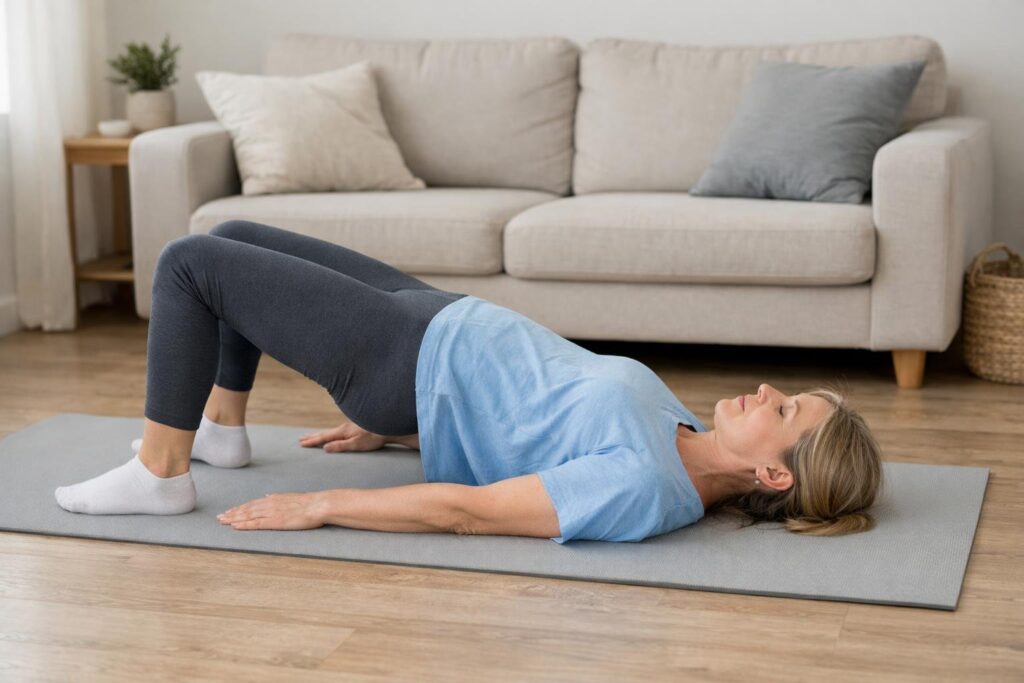
Back in the supine position, feet flat on the floor. Lift your pelvis until your thighs and torso form a straight line, hold for a few breaths, and then roll back down vertebra by vertebra. This strengthens the glutes and back extensors without putting weight on the spine.
How Much Pain is Acceptable While Exercising?
A slight pulling or dull tension is permissible, especially at the beginning. Such sensations do not mean that something is breaking. If the pain subsides quickly after the exercise, you are on the right track.
It’s different if a movement causes sharp pain, if the pain radiates into the leg, or if there is tingling and numbness there. In that case, skip that exercise and discuss it with your doctor or physiotherapist. The same applies if the discomfort is significantly worse the day after training than it was before: the workload was too much, not the movement itself.
Pain relievers can help in the acute phase to get moving at all. Whether and which medication is suitable for you will be determined by your doctor or pharmacist.
When You Should See a Doctor Immediately
In the presence of the following signs, do not exercise but seek clarification. Call emergency services at 112 or go to an emergency room if any of the following accompanies your back pain:
- Numbness in the genital or anal area or on the inner thighs;
- Sudden inability to hold urine or stool, or inability to empty the bladder;
- Weakness or rapidly increasing weakness in one or both legs;
- Severe pain after a fall or accident;
- Fever and chills along with severe back pain.
Additionally, you should see a doctor promptly for pain that increases at night and at rest, unintentional weight loss, or back pain with a known history of osteoporosis or cancer.
If It Still Hurts After Six Weeks
Doctors refer to pain as acute up to six weeks, subacute after that, and chronic after more than twelve weeks. With duration, the recommendations change. For subacute and chronic complaints, movement therapy should be the central treatment according to the guidelines, combined with education on how pain arises and why loading does not harm the back.
This refers to guided training that gradually increases strength, endurance, and flexibility. The doctor can prescribe physiotherapy for this. If your ability to cope in daily life or work remains limited for a longer period, the guidelines also recommend rehabilitation sports or functional training in a group; this too will be prescribed by a doctor. An MRI is not automatically included – whether an imaging is sensible will be determined by the examination.
Keep Going When the Pain is Gone
Most people stop as soon as the pain subsides. Understandable. However, the back benefits most from what comes next. The World Health Organization recommends that adults engage in 150 to 300 minutes of moderate-intensity aerobic activity per week, along with exercises that strengthen the major muscle groups on at least two days. Brisk walking counts, as does cycling to work.
A few things can make it easier to stick with it:
- Set times. Ten minutes after getting up are more likely to become a habit than “sometime this week.”
- Interrupt sitting – stand while on the phone, take the stairs, go for a walk during lunch breaks.
- A class with others if you find it hard to get started alone. Many statutory health insurance companies subsidize certified prevention courses; ask your insurer.
Chronic stress and poor sleep also keep back pain alive. Working on both helps your back.
Frequently Asked Questions
Can I exercise while my back still hurts?
Yes, for non-specific back pain, in an adapted form. Start with walking and light exercises and gradually increase over days. Sports involving jumps, quick turns, or heavy weights are better postponed until the acute pain has subsided.
Is swimming better than strength training?
There is no clear winner. Choose what you enjoy and what you can do regularly. Some combine both.
Do I need physiotherapy for the exercises?
Not necessarily for the start. Guidance is sensible if you are unsure whether you are performing the movements correctly, if the complaints last longer than a few weeks, or if you are hardly doing anything out of fear of pain.
Does a support belt help with training?
The guideline advises against orthoses for non-specific back pain. The back should learn to support itself.
Also Read
- Slipped Disc: What Helps in the First Days
- MRI for Back Pain: When Imaging is Sensible
- Stress Management and Burnout Prevention: Ways to More Well-Being in Everyday Life
- Sleep Medicine: Healing for Sleep Disorders and Ways to Restful Sleep
This article is for informational purposes only and does not replace medical advice.
Sources
- German Medical Association (BÄK), National Association of Statutory Health Insurance Physicians (KBV), Association of Scientific Medical Societies (AWMF). National Guideline for Non-specific Back Pain – Long Version, 2nd Edition. 2017. AWMF Register No. nvl-007.
- World Health Organization. WHO guidelines on physical activity and sedentary behaviour. Geneva: World Health Organization; 2020.